Complete documents as the basis
Tenders for spare parts and equipment follow fixed rules – whether they are issued by public authorities, construction companies or industrial firms. As a rule, a bid is only evaluated if it meets all formal and technical requirements and is submitted on time. Missing evidence or deviations from the requirements can lead to exclusion.
A sound bid therefore requires the complete tender documents, not just an extract. These usually include:
- the schedule of requirements or technical specification,
- quantities, lots and the price schedule,
- delivery and payment terms,
- deadlines and formal requirements for submission,
- the list of required supporting documents,
- requirements for packaging, marking and shipping documents,
- all addenda and the answers to bidders’ clarification questions.
Schedule of requirements and technical specification
The schedule of requirements describes what is to be supplied. For spare parts, it serves its purpose when every item can be identified unambiguously:
- the manufacturer’s part number and the description of the part,
- manufacturer, type and serial number of the machines the parts are intended for,
- technical parameters such as dimensions, power, pressure or voltage,
- standards or test specifications that must be met.
“Or equivalent”
Many tenders state a part number followed by “or equivalent”. What matters then is whether equivalent parts from other manufacturers are permitted and how equivalence must be demonstrated – for example with data sheets, drawings or cross-reference lists.
Clarify ambiguities early
Contradictions between the schedule of requirements, drawings and quantities do occur. Most procedures allow clarification questions from bidders within a set period. The answers often become part of the tender documents and should form the basis of the bid.
Quantities, lots and price schedule
Quantities determine sourcing, packaging and transport. Pay particular attention to:
- Units of measure: piece, set, kit or metre – a “set” of seals may contain a different number of parts depending on the manufacturer.
- Lots: whether bids may be submitted for individual lots or only for all items together.
- Options and framework quantities: whether the quantities are fixed or called off as required.
- Price schedule: prescribed forms, currency, price basis and whether packaging and transport must be shown separately.
Delivery terms, Incoterms and deadlines
The delivery term defines up to which point the supplier bears costs and risk. It is usually stated in accordance with Incoterms® 2020, for example:
- FCA (Free Carrier): handover to the buyer’s carrier at the agreed place.
- CFR and CIF (Cost and Freight; Cost, Insurance and Freight): the seller pays the sea freight to the port of destination, and under CIF the insurance as well. Risk passes as soon as the goods are loaded at the port of shipment.
- DAP (Delivered at Place): delivery to the named place in the country of destination, not cleared for import.
- DDP (Delivered Duty Paid): delivery to the named place with duties and taxes paid.
A clause must always be accompanied by a precisely named place, such as “CIF Port of Algiers” or “DAP consignee’s warehouse in Tunis”.
Deadlines
- Bid deadline: date, time and form of submission, on paper or electronically.
- Deadline for clarification questions.
- Bid validity period: how long the bid must remain valid.
- Delivery date: counted from contract award, from signature of the contract or from receipt of an advance payment or letter of credit.
Especially for spare parts with long manufacturer lead times, the reference point for the delivery date determines whether a deadline is realistic.
Evidence, certificates and documents
Tenders often require evidence relating to the bidder and to the goods. Which documents are required is stated in the tender documents, often as a separate list. Typical examples are:
Relating to the company
- an extract from the commercial register,
- certificates confirming payment of taxes and social security contributions,
- references for comparable supplies,
- bank references or guarantees, such as a bid bond or performance bond.
Relating to the goods
- a certificate of origin or declaration of origin,
- a manufacturer’s declaration or declaration of conformity,
- inspection documents, for example test reports or inspection certificates to EN 10204,
- data sheets and, for chemicals, safety data sheets as well.
The formal requirements are just as important: the language of the documents, certified translations, and certification by the chamber of commerce or legalisation by a consulate. These steps take time and should be part of the planning from the outset.
Packaging and marking
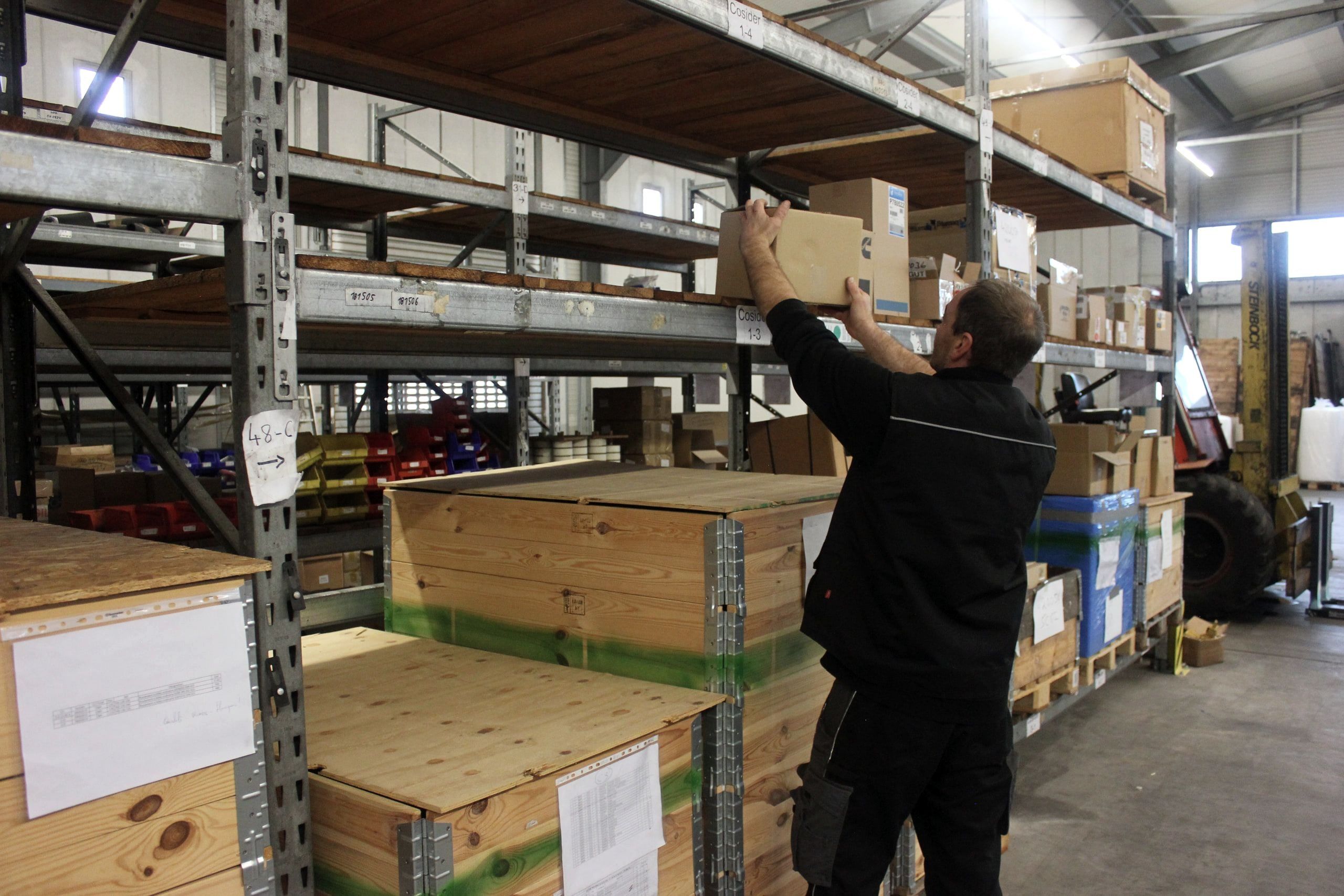
Packaging and marking requirements are easily overlooked, yet they are part of the contractual scope of supply. Common requirements include:
- Seaworthy packaging, for example in wooden crates. For export to many countries, wood packaging must be treated and marked in accordance with ISPM 15.
- Marking of packages with the order or tender number, consignee, destination, package number, gross and net weight and dimensions.
- Marking of the parts with the part number and the item number from the schedule of requirements.
- Packing list for each package.
- Dangerous goods, such as certain chemicals: packaging and marking in line with the regulations for the respective mode of transport.
For more on packaging and shipping, see Export & logistics.
Summary
A bid is only as sound as the documents it is based on. The more complete the schedule of requirements, quantities, delivery terms, deadlines, evidence and packaging requirements, the more precisely sourcing, costs and schedules can be planned.
We analyse tender documents, match the requirements against our knowledge of the target markets, prepare the bid and support the project through to implementation – see Tenders for details. Send us the documents via the enquiry page or by email to info@exportgmbh.de.